By Dr. Uzma Jabeen | MBBS, FCPS Pediatric Medicine | Consultant Pediatrician Last Reviewed:August 2026 | Child Health Club
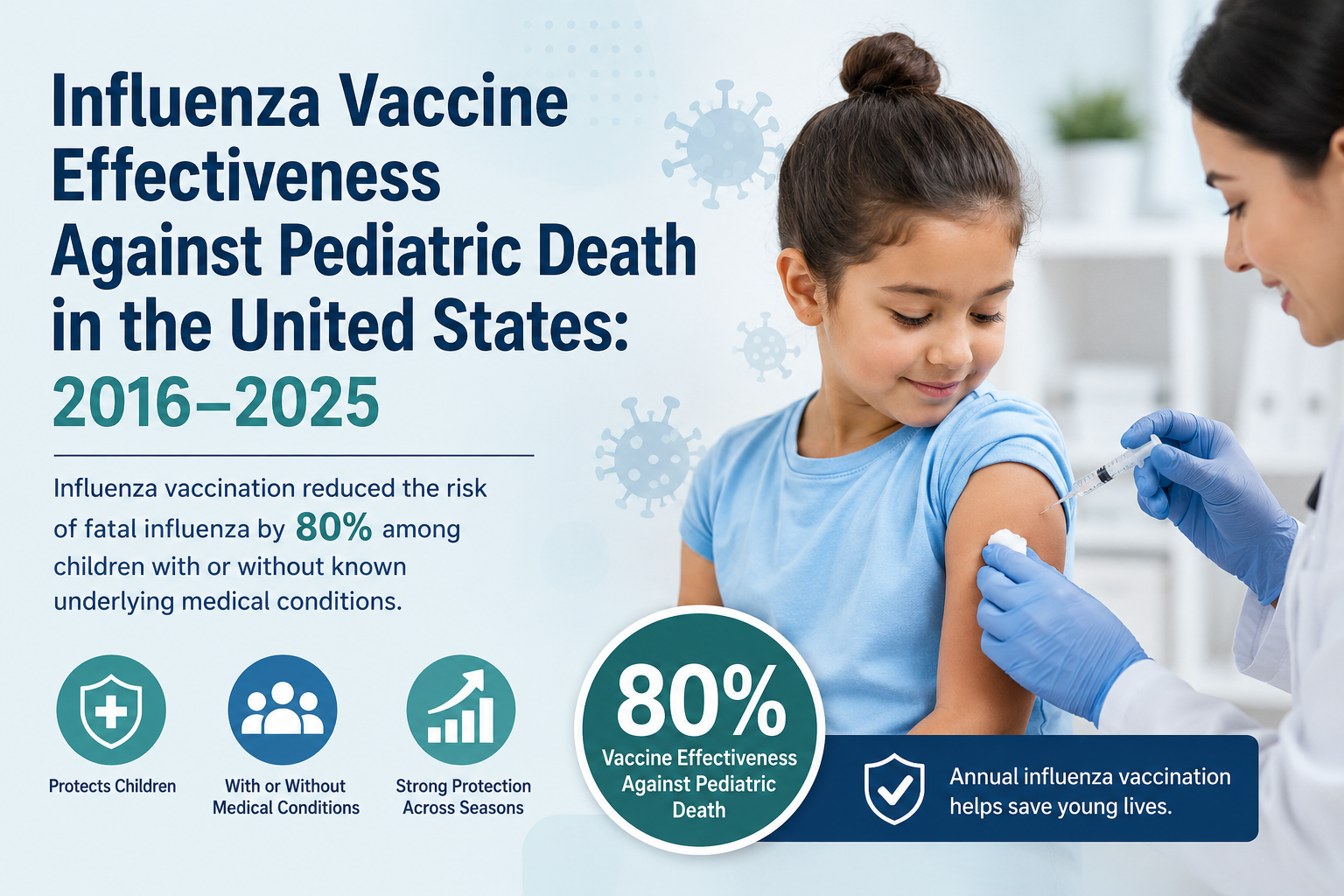
If you’ve ever hesitated over the yearly flu shot decision for your child, a new study gives one of the clearest answers yet. Researchers analyzing eight flu seasons of national surveillance data found that flu vaccine effectiveness in children against death was 80% — meaning fully vaccinated kids were dramatically less likely to die from flu-related complications than unvaccinated kids of the same age living in the same state.
The study, published in Pediatrics in August 2026 by a team from the CDC’s Influenza Division, is the most comprehensive look yet at how well the flu shot for kids protects against the worst possible outcome. Here’s what the data actually shows, and what it means for your family.
The Study
Researchers looked at every laboratory-confirmed influenza-associated pediatric death reported to the CDC’s national surveillance system from October 2016 through September 2025 (excluding the unusually quiet 2020–2021 season). They then compared how many of those children had been vaccinated against how many children in the general population, of the same age and state, were vaccinated that season.
This comparison produces what’s called vaccine effectiveness (VE) — a percentage that reflects how much a vaccine lowers your risk relative to not being vaccinated. An 80% VE doesn’t mean 20% of vaccinated kids still got seriously ill; it means the odds of a fatal flu case were about 80% lower among fully vaccinated children than unvaccinated children.
Key Results From the Study
- 1,234 laboratory-confirmed pediatric flu deaths were reported over the study period among children ages 6 months to 17 years.
- Of children whose vaccination status was known, only 17–18% were fully vaccinated at the time of their fatal illness.
- Overall vaccine effectiveness against pediatric flu death was 80% (95% CI, 75–84%).
- VE was 87% among children with no known underlying health conditions.
- VE was 77% among children with an underlying high-risk medical condition (such as asthma, a neurologic disorder, or a heart condition).
- The 2024–2025 season had the highest number of pediatric flu deaths ever recorded — 252 — since national reporting began.
Why Unvaccinated Children Are at Higher Risk
The pattern in this data is striking: across nearly every subgroup analyzed — by age, sex, race, ethnicity, and virus type — the large majority of children who died from flu had not received a current-season flu vaccine. Average flu vaccination coverage among U.S. children during the study period hovered around 49%, yet only about 18% of children who died from flu were fully vaccinated.
That gap is the core evidence behind the vaccine effectiveness estimate. It’s not just an association — the researchers used a validated epidemiological method (the “screening method,” used since the 1990s to estimate VE for many vaccines) that accounts for age, location, and season to isolate the effect of vaccination itself.
It’s also worth noting: this doesn’t mean flu vaccination guarantees complete protection. Some fully vaccinated children in the study still died from flu-related illness. But even accounting for that, unvaccinated children in comparable circumstances faced a substantially higher risk.
What This Means for High-Risk Kids
About half of the pediatric flu deaths in this study — 48% — occurred in children with at least one underlying medical condition known to raise the risk of severe flu, including:
- Asthma
- Neurologic or neuromuscular disorders
- Congenital heart disease
- Genetic or mitochondrial conditions
- Immunocompromising conditions
For these children, vaccine effectiveness against death was slightly lower than for children without underlying conditions (77% vs. 87%), which likely reflects both their greater baseline vulnerability to severe illness and the biological challenges some conditions pose to full immune response. Even so, a 77% reduction in risk of death is a substantial protective benefit — and it reinforces existing pediatric guidance that children with chronic conditions are a vaccination priority, not a group for whom vaccination matters less.
Importantly, the other half of pediatric flu deaths occurred in children with no known underlying health conditions — and vaccination rates in that group were even lower (only 12% were fully vaccinated). This is a key takeaway for parents: a healthy child is not a low-priority child when it comes to flu vaccination.
Study Limitations
No single study is perfect, and the authors were transparent about several limitations:
- Only lab-confirmed deaths were counted. Some flu deaths without a positive lab test weren’t included, so the true toll may be higher.
- Vaccination records weren’t always complete. If a vaccinated child’s shot wasn’t recorded in the systems reviewers checked, it could make the vaccine look slightly more effective than it truly is.
- Underlying health conditions may be under-documented, especially for children who died before ever being hospitalized.
- Survey-based vaccination coverage estimates (used for comparison) may be inflated because parents sometimes over-report vaccination in surveys. The researchers tested this by lowering assumed coverage by 10% and 20% in sensitivity analyses — and even in the most conservative scenario, vaccine effectiveness remained statistically significant across every age group.
These are the same caveats you’d expect in any large observational surveillance study, and the authors’ sensitivity analyses suggest the core finding — that vaccination substantially reduces risk of pediatric flu death — held up under scrutiny.
Clinical Perspective
In more than 20 years of pediatric practice, I’ve had the flu vaccine conversation with parents thousands of times, and I’ve watched the tone of that conversation shift over the years.
One pattern in the data matches what I’ve seen at the bedside: families often assume a healthy child without any chronic conditions is “low risk enough” to skip or delay the flu shot. This study is a useful, evidence-based counter to that assumption — roughly half of the pediatric deaths occurred in children with no known underlying health conditions. I try to make this point early in well-child visits each fall, before flu season is in full swing, rather than waiting until a family is already anxious about a sick child in front of me.
For families of children with asthma, neurologic conditions, or other chronic illnesses, I don’t read the slightly lower effectiveness estimate (77% vs. 87%) as a reason for hesitation — if anything, it’s the opposite. These are exactly the children for whom every additional layer of protection matters most, and a roughly 4-in-5 reduction in risk of death is a substantial benefit for a child who may already have less physiologic reserve to weather a severe infection. I frame it with parents as “this vaccine works very well for your child specifically — and your child is also the one who benefits most from every layer of protection we can add.”
Practical Takeaways for Parents
When should my child get the flu shot? The CDC generally recommends flu vaccination for everyone 6 months and older, ideally by the end of October, though vaccination later in the season still provides protection for the remainder of it.
My child is healthy — do they still need it? Yes. This study found that roughly half of pediatric flu deaths occurred in children with no underlying health conditions at all.
Does the flu shot fully guarantee my child won’t get seriously ill? No vaccine is 100% effective. But this study found vaccinated children had about an 80% lower risk of dying from flu-related complications compared to unvaccinated children — a large and consistent protective effect across age groups and eight flu seasons.
Is one dose enough for young children? Some children ages 6 months through 8 years who haven’t been vaccinated before need two doses in their first vaccinated season, spaced at least 4 weeks apart, to be considered fully protected. Ask your pediatrician about your child’s specific dosing schedule.
What if my child has asthma or another chronic condition? Talk to your pediatrician about vaccination timing — high-risk children are a priority group for flu vaccination, not a group where vaccination matters less.
References
- Leonard JS, Reinhart K, Lu P-J, et al. Influenza Vaccine Effectiveness Against Pediatric Death in the United States: 2016–2025. Pediatrics. 2026;158(2):e2026076453. https://doi.org/10.1542/peds.2026-076453
- Flannery B, Reynolds SB, Blanton L, et al. Influenza vaccine effectiveness against pediatric deaths: 2010–2014. Pediatrics. 2017;139(5):e20164244.
- Reinhart K, Huang S, Kniss K, Reed C, Budd A. Influenza-associated pediatric deaths — United States, 2024–25 influenza season. MMWR Morb Mortal Wkly Rep. 2025;74(36):565–569.
- O’Leary ST, Campbell JD, Ardura MI, et al. Recommendations for prevention and control of influenza in children, 2025–2026: policy statement. Pediatrics. 2025;156(6):e2025073620.
- Scott J, Abers MS, Marwah HK, et al. Updated evidence for COVID-19, RSV, and influenza vaccines for 2025–2026. N Engl J Med. 2025;393(22):2221–2242. (Cited in the source study as the source of a pooled meta-analysis estimate of 67% vaccine effectiveness against influenza-associated hospitalizations in infants and children.)
- Centers for Disease Control and Prevention. Flu vaccination coverage, United States, 2024–25 influenza season. FluVaxView. Published January 8, 2026.
About the Author
Dr. Uzma Jabeen is a Consultant Pediatrician with MBBS and FCPS in Pediatric Medicine. With extensive clinical experience in neonatal and child health, she founded Child Health Club to bridge the gap between complex medical research and everyday parenting. Her mission is simple: every child deserves care backed by evidence, and every parent deserves to understand it. She writes regularly on neonatal outcomes, childhood illness, and evidence-based parenting.
Disclaimer: This article is for informational purposes only and summarizes findings from a peer-reviewed CDC surveillance study published in Pediatrics. It is not a substitute for individualized medical advice. Please consult your child’s pediatrician about vaccination decisions specific to your child’s health history.
© Child Health Club. All rights reserved. Please do not reproduce without permission.